Pod
founder & CEO · 2022 →The problem
Sellers were drowning in everything except selling.
The best account executives I have worked with all shared the same quiet frustration. Their evenings went to account research, their mornings to follow-ups, their Friday afternoons to apologizing to the CRM. The actual selling, the conversations that move a deal forward, kept getting squeezed into whatever time was left. Every tool they were given added a tab; none of them gave time back.
Pod started in 2022, in San Francisco, from that gap. The question we kept returning to was simple to say and hard to build: what if the work around selling could run itself?
The platform
Not another sales assistant.
We did not set out to build another AI sales tool. Sellers have plenty of those, and most of them stop at summarizing work instead of doing it. Pod was built for the next step: an agentic orchestration platform that understands business context, reasons across it, and participates in the workflow with people in control. Three layers, each hard to build and harder to rebuild: context, intelligence, orchestration.
Layer one · context
Where a deal actually lives.
A deal is not a CRM opportunity. It is a changing collection of people, meetings, objections, commitments, follow-ups, and risks scattered across the system of record, the system of communication, and the system of work. The CRM holds the official story; the email threads hold the real one; the call transcripts hold the parts nobody wrote down.
Pod's context layer connects all of it: CRM, email, calendar, meetings, transcripts, documents, and workflow signals, reconciled around the business objects that matter. The same human being might appear as a calendar attendee, an email sender, a CRM contact, and a transcript speaker; Pod knows they are one person in one buying group. That consolidation sounds unglamorous, and it is exactly what makes everything above it possible.
Layer two · intelligence
From data to judgment.
Connecting data is only the first step. The intelligence layer turns that raw, fragmented information into sales-aware understanding: enrichment and signal extraction, semantic search across everything the team has ever said or written, playbooks encoded so the system knows what good looks like, and durable memory so no interaction starts from a blank slate.
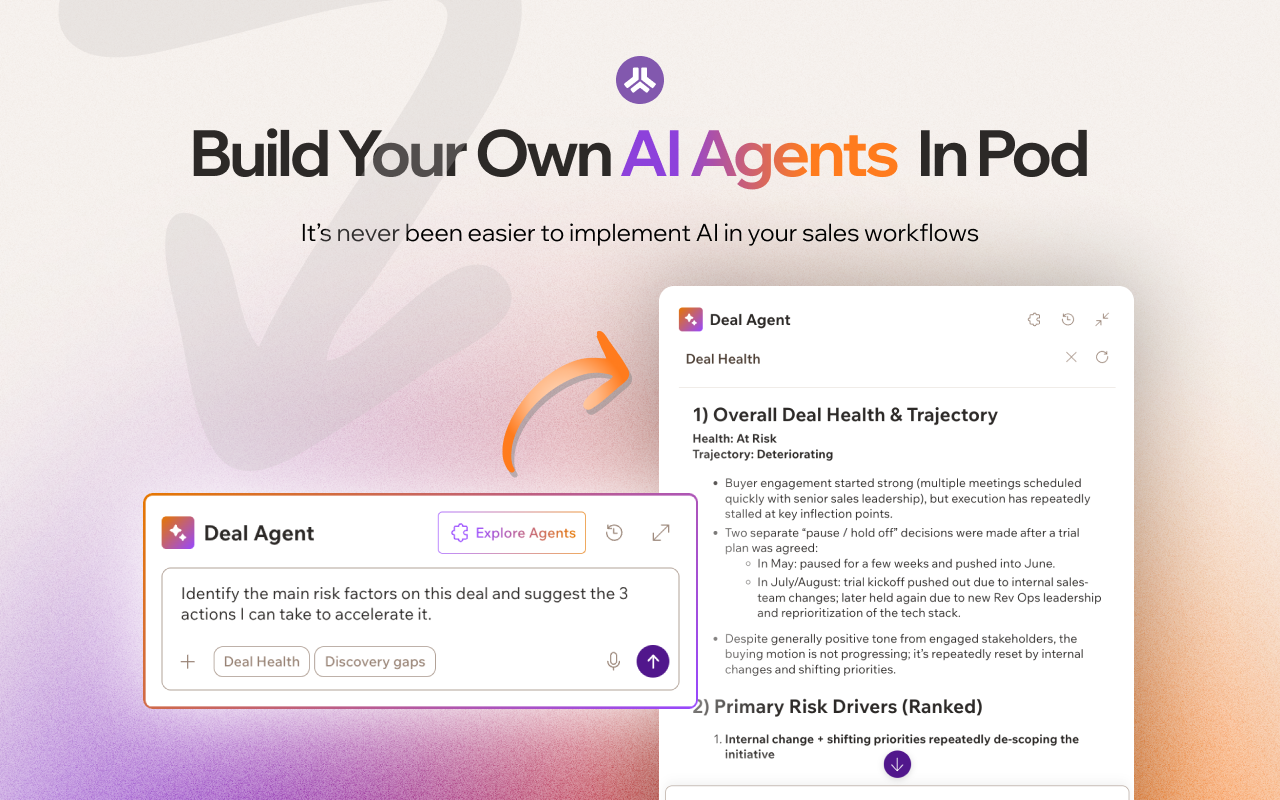
This is the layer that reads a deal and forms an opinion: who is involved, what has changed, which risks are live, what the workflow needs next. We also treated agent quality as an operational system rather than a leap of faith, with evaluation and review loops around agent behavior, because judgment you cannot inspect is judgment nobody will trust.
Layer three · orchestration
Agents that participate, with people in control.
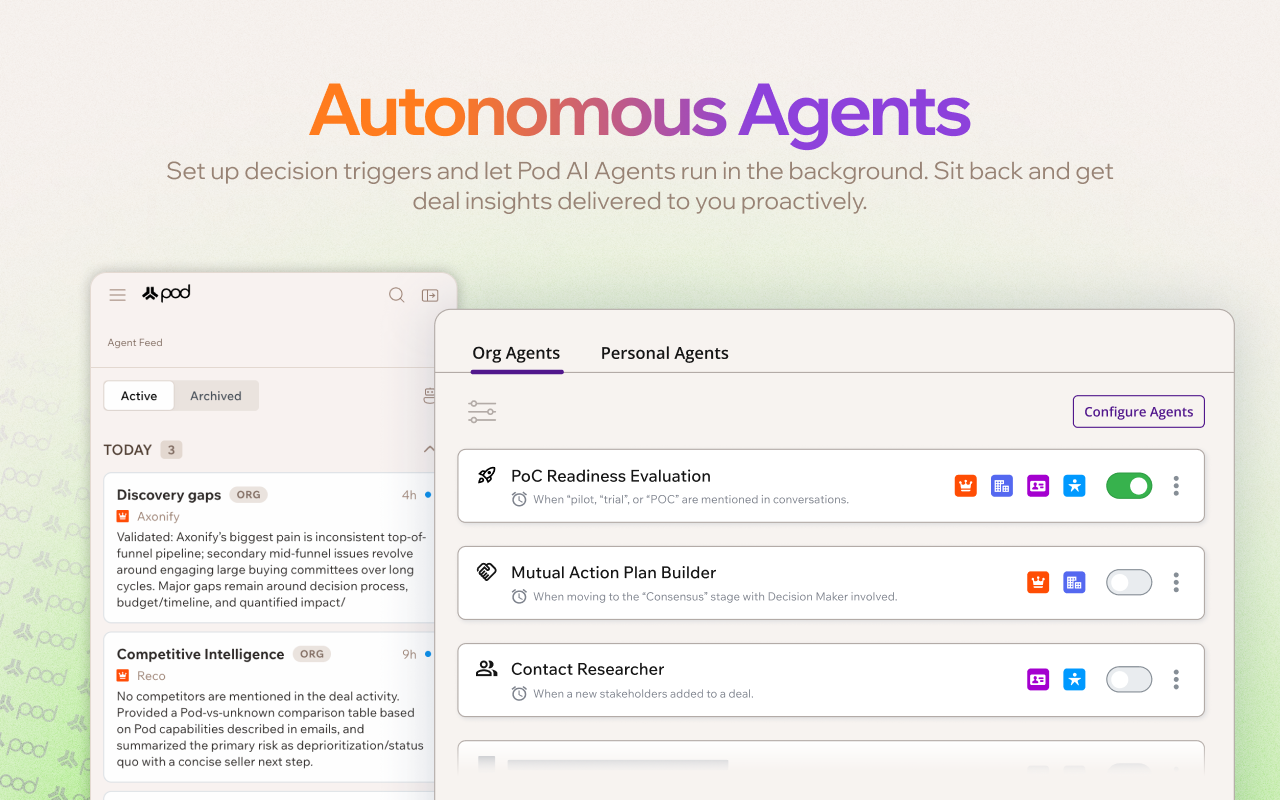
The orchestration layer is where understanding becomes work. Agents run when a seller asks, and also when the system decides work should happen: a scheduled trigger, a workflow condition, a deal that just went quiet. They carry tools for the real systems, propose actions through approval flows, handle retries and failures, and leave an auditable trail. Controlled participation, not unmanaged autonomy.
For maximum flexibility we built both an MCP client and an MCP server, so Pod's agents could reach external tools and other systems could reach Pod's context. But the conviction underneath it all was about embedding: agents inside the seller's actual workflow, in the web app, the extension, the feeds and approval cards, rather than in one more assistant tab that nobody opens twice.
My part
Four hard problems, taken personally.
I founded Pod and carried the CEO seat end to end: the team, the $3M seed round, the product calls, and the exit. But the honest version of my part is a list of the problems that kept me up. Moving from a product-led motion to a top-down enterprise motion, which changes everything: who you sell to, what they buy, how long it takes, and what the product has to prove. Finding product-market fit in a category that was being invented and reinvented under our feet.
And then the two problems every founder in a hot space knows: building a product 10x better than what was out there, in one of the busiest markets in software, and finding distribution in that same crowd. Being right about agents early was not enough; we had to be findable, believable, and better on a demo-by-demo basis.
The impact
What I'm proudest of.
The customer impact came first: watching revenue teams actually change how they run, sellers walking into meetings prepared by an agent that read everything, managers and CROs adopting AI not as a mandate but because their pipeline reviews got sharper. Getting a skeptical enterprise seller to trust an agent with their follow-ups is a harder sale than the software itself, and we made it hundreds of times.
Internally, we ran the way we preached: a team of about eight, with processes so AI-powered that the company operated like one several times its size. The team we built, small, senior, and relentless, is the thing I am proudest of from these years.
- Supported hundreds of sellers across 100+ revenue teams
- Sellers, managers, and CROs changing how they operate with AI
- Internal processes AI-powered end to end
- A team of ~8 punching far above its weight
The outcome
An exit that reads like a thesis.
In September 2026, Pod was acquired by Backstory (formerly People.ai), the enterprise revenue-intelligence platform used by revenue orgs like AMD, OpenAI, and Red Hat. The whole team came along, engineering and go-to-market, and joined Backstory’s CX team as one unit rather than a bolt-on. The fit is the thesis we spent four years building toward: agents do agent work, people do people work, and the same answer reaches the rep preparing a call, the manager reviewing pipeline, and the executive looking at the quarter, from one system.
Further reading